Last night in Eugene, Oregon, Tate Taylor, an 18-year-old from San Antonio, Texas, joined an elite fraternity: World U20 100m champions. Facing off against one of the more decorated U20 fields in recent history -- one that included three athletes with sub-10-second credentials -- Taylor ran a PB of 9.94, beating Jamaican U20 national record holder Gary Card by .11 seconds.
To anyone who's followed Taylor's meteoric rise the past few years, this result didn't come as much of a surprise. As a high school junior, Taylor qualified for the semi-finals at the senior U.S. Championships in the 100m and won a Texas state high school title in the 200m in a blistering and wind-legal 20.14.
This outdoor campaign he's eschewed high school competition in favor of mixing it up with the professionals, and has looked -- excuse the lack of journalistic neutrality for a moment -- frankly, incredible. He won the 200m at the Pre Classic in 19.75... into a headwind... against Diamond League-level professional competition. And across 20+ races he's entered in 2026, he hasn't finished worse than third.
Taylor will head to Texas Tech in the fall as perhaps the most exciting teenage sprint prospect in American history, a statement that's inclusive of a prominent name we'll come back to shortly.
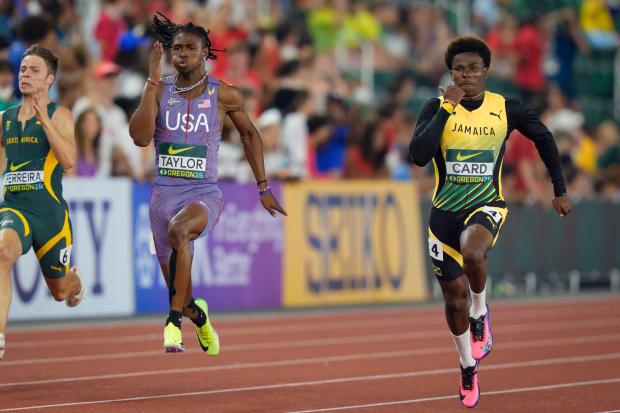
Photo: Ben Lonergan/The Register-Guard
His first U20 title -- he'll vie for another in the 200m during this championship -- has to mean he's a lock to become the next... dare we say it?... Usain Bolt, right?
Let's take a very brisk stroll down memory lane to discuss the careers of the winners of the previous five U20 men's 100m races.
In 2024 it was South Africa's Bayanda Walaza. That same summer he suited up for the South African national team at the Paris Olympics and led off the 4x100m relay squad that took home silver. Still just 20 years old, Walaza has developed into one of the fastest men on the planet with a 9.89-second 100m PB, run last month. He's competed in a Diamond League Final and continues to be a mainstay on the always very good South African 4x100m relay squads in international competition. It's safe to say that Walaza has become a legitimate star, and will likely continue to improve given his age. He may not be a household name, but should he snag an Olympic or World medal in the next decade, it won't be like he came out of nowhere.
In 2022 it was Botswana's Olympic and World champion Letsile Tebogo. In 2021 it was also Tebogo. To win U20s twice is an incredible feat -- to pull it off, you're beating athletes a year or two older than you at a stage in your career where that absolutely matters. So it's no shock that Tebogo has gone on to be one of the greatest sprinters of his era. He won the 2024 Olympic gold medal in the 200m, and snagged additional hardware on four other occasions at global championships. When healthy, Tebogo is near unbeatable over 200m and is a guarantee to deliver an eye-popping split on the 4x400m relay. He's an even better example of a U20 championship serving as a springboard to senior-level greatness.
In 2018 it was Indonesia's Lalu Muhammad Zohri, whose winning time of 10.18 established a national U20 record. Since breaking the tape in Finland in 2018, Zohri has claimed possession of basically every major Indonesian short sprinting national record. The only thing is, those national records just aren't globally competitive for the most part. He's run 10.03 for the 100m, and that could possibly sneak you into a global final if the injury chips fall in your favor, but realistically, he isn't going to match his U20 success at this level, short of a major breakthrough. Zohri is the one counterexample we'll cover of a U20 100m title not predicting success at the next level, but he is still -- and will forever be -- a U20 champion. Not to mention probably the best ever short sprinter from the fourth-most populous country on earth!
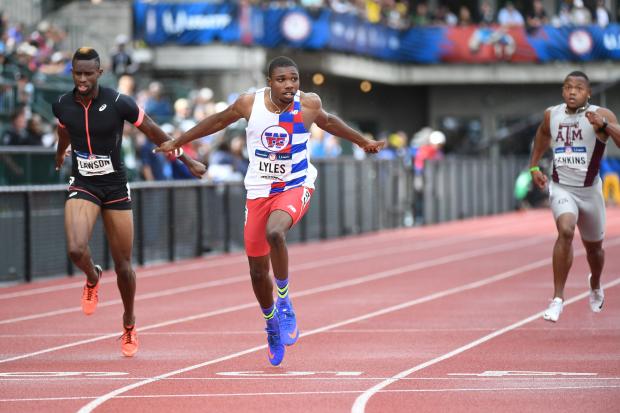
Photo: James Lang
And in 2016, the U20 100m titleholder was American Noah Lyles, who, like Tebogo, is an Olympic and World champion. What else do we have to say about Lyles? He was a high school prodigy who -- much like Taylor -- scrapped it up with the professionals while still a teenager. He went pro right after wrapping up his prep career, and really hasn't had a serious misstep since. He's the American record holder in the 200m and the third fastest man ever in that event. He won Olympic gold in the 100m -- not even his best event -- in addition to a whopping eight World Championship gold medals. It's hard to remember a 100m or 200m race he's been entered in over the past six years where he wasn't the favorite coming in. It's safe to say that Lyles is the poster child for transitioning from U20 success to senior-level greatness.
If you've made it this far, you probably already drew the conclusion we're about to reach here: Tate Taylor appears to be on the same trajectory as a Lyles or Tebogo. He was really fast last year. He got even faster this year, and in the process has honed the sorts of skills he'll need at the professional level: racing against experienced vets, traveling to distant time zones, running rounds, etc.
We're inclined to believe that Taylor will win a global medal in the 100m, 200m, or both, sometime in the next decade. If he pulls it off at the Los Angeles Olympics in two years, that'll be both cinematic and... not entirely unexpected. He'll have a year or two of NCAA-level training and competition under his belt, and as a perusal of the NCAA Championship's results from recent years will tell you, it's a truly world class developmental system.
However, in the interest of not putting undue pressure on an already accomplished and high-striving young athlete, even if he doesn't improve a lick between now and the conclusion of his very likely long professional career, he'll still be in position to do incredible things. He won a highly competitive Diamond League 200m as a kid! He's run world class times in the 100m and 200m. He's demonstrated poise all along the way. There are 30-something-year-old men who are on professional contracts
right now who would kill to have Taylor's resume from this year alone.
Nothing comes easy in this sport. And we should never take a young star's future success for granted. So we'll conclude with this: anytime Taylor races, it's worth paying attention -- whether that's the first round of the 60m at the Big 12 Indoor Championships next winter, or an Olympic final in 2028.